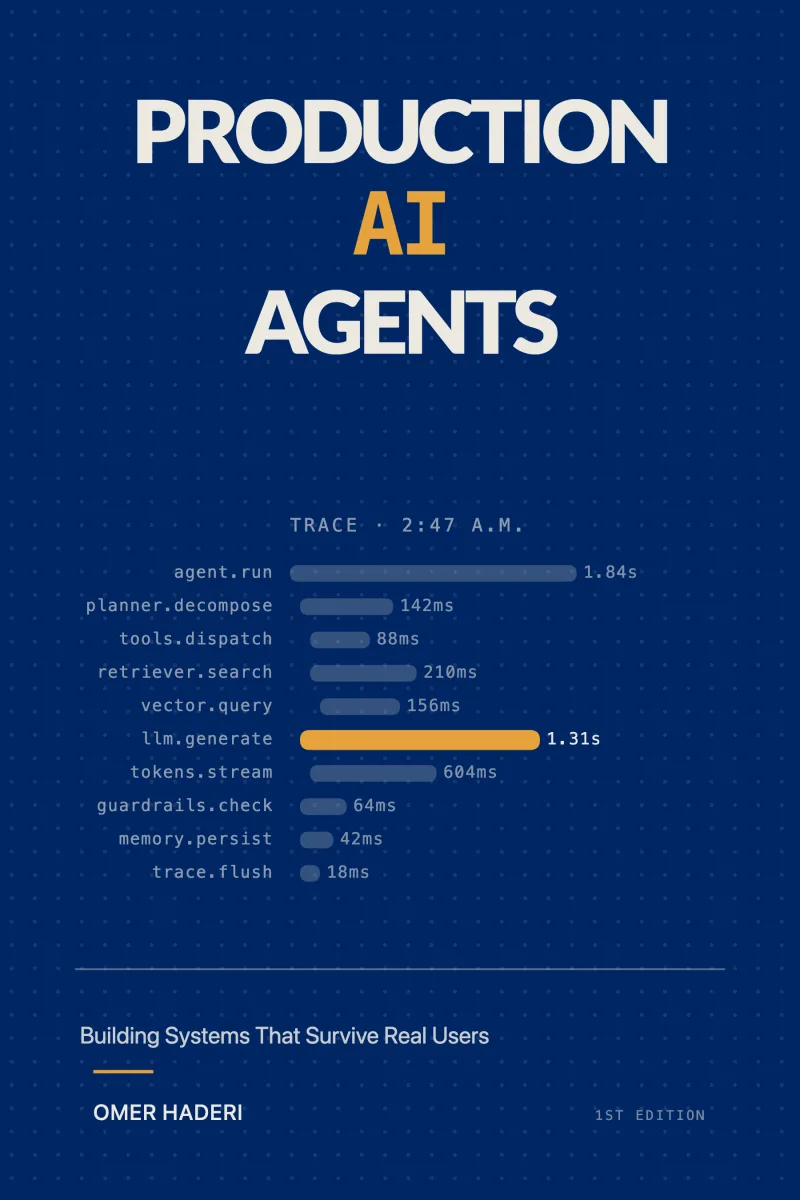
Building systems that survive real users.
Orchestration, evals, observability, cost, security, rollout: the careful machinery that takes your agent from a working demo to a deployed system.
PDF · Companion repo
Your agent demo works.
Your production agent doesn't.
Most agent tutorials end at the working demo. This book starts there.
You'll build a real Site Reliability Engineering agent, one that diagnoses incidents under live fault injection, is scored by an eval harness, blocks its own regressions in CI, traces every step, stays inside a token budget, survives prompt injection from hostile logs, and rolls out one action at a time as it earns trust. Not a notebook demo. The kind of agent you could put on call.
Who this book is for
If you're comfortable with Python, Docker, and the basic shape of a microservice, you have everything this book needs.
# the agent grows one capability per chapter, tagged in git
$ git checkout ch07
$ make agent-run

▸ recall similar past incidents      ok (0)
▸ gather: promql_query, log_search   ok
▸ hypothesis: slow-query on orders   ok
▸ propose: rollout-restart orders    proposed
▸ remember incident for next time    ok

$ make agent-eval RUNS=5
judge agreement 1.0  · trustworthy
correctness 0.6 · safety 1.0 · 8 steps
What you'll build
An SRE agent that runs against a live synthetic chaos environment.
- ✓Six-service microservice topology with live fault injection
- ✓Full telemetry stack: Prometheus, Grafana, Loki, Tempo
- ✓Durable orchestrator with crash recovery and replay
- ✓Three-tier state: task log, conversation, incident memory
- ✓Six defensive tools with schemas and contract tests
- ✓An eval harness with a validated judge
- ✓A CI deploy gate that blocks the agent's own regressions
- ✓End-to-end OpenTelemetry tracing across agent and services
- ✓Per-incident token budgets and cache-friendly context
- ✓Guardrails that survive prompt injection from hostile logs
- ✓Progressive rollout from shadow to autonomous, per action
- ✓A verifier agent, justified only where it earns its cost
What's inside
The first two chapters set the scene. From chapter 3 onward, each chapter adds a layer that lives behind a git tag, so you can check the agent out as it stood at the end of any chapter.
-
ch01
What Production-Grade Means for AgentsThe 02:47 incident that opens the book, and what it tells us about the work an SRE agent actually has to do. Why most agents that work in a demo never reach this kind of shift.
-
ch02
The Anatomy of a Production AgentThe eight components of a production agent (rollout, guardrails, orchestrator, state, executor, tools, observability, evals) and the failure mode each one prevents. Sets up the reference agent the rest of the book builds.
-
ch03
Designing for Capability and BoundaryScope config as the agent's first artifact: in-scope, frontier, out-of-scope, forbidden actions. The agent can state what it will and will not do.
-
ch04
Orchestration and Control FlowA durable orchestrator and executor with checkpoint and replay. The agent runs a checkpointed investigation and survives a worker crash mid-run.
-
ch05
State and MemoryTask state in Postgres, conversation in Redis, long-term memory in a vector store. The agent recovers coherent state and recalls past incidents.
-
ch06
Tools and IntegrationsSix defensive tool wrappers with schema validation and contract tests. The agent queries metrics, logs, traces, deploys, and runbooks through tested boundaries.
-
ch07
Building an Eval HarnessStep and trajectory evals scored against the chaos scenarios. The agent is now measurable on diagnosis correctness, safety, and efficiency.
-
ch08
Evals as Deployment GatesA CI gate with baselines and per-dimension thresholds, plus production sampling. The agent blocks its own deploys on a regression.
-
ch09
Observability and TracingOpenTelemetry tracing, semantic logs, two-family drift detection. Reconstruct any run; surface drift before failures get loud.
-
ch10
Cost and Latency EngineeringPrompt-cache-friendly context assembly, model routing, per-incident token budgets. Diagnose under a budget; wrap up gracefully when it's spent.
-
ch11
Security and GuardrailsInput guardrails, credential-level permission scoping, action gates. Injection becomes survivable: the deterministic layers contain it.
-
ch12
Human-in-the-Loop and RolloutShadow, assisted, and autonomous modes per action, with an approval surface. Actions graduate individually as they earn trust.
-
ch13
When Multi-Agent Earns Its CostA targeted verifier agent, invoked only on the hard incidents. Measure whether a second agent is worth its tokens, and where.
Three Field Notes chapters run the same chaos day against the agent at three milestones: after the architecture is complete (ch06), after it's proven and observable (ch09), and after the shipped rollout (ch12).
What this book is, and what it isn't.
This book builds one specific agent: a Site Reliability Engineering agent that diagnoses incidents in a synthetic microservice environment. That agent is a vehicle, not the destination.
The destination is everything the chapters teach you while building it. Orchestration, durable state, defensive tools, eval harnesses, deploy gates, observability, cost discipline, guardrails, rollout policy. These transfer to whatever agent you're shipping next, whether it answers support tickets, drafts contracts, or runs your build pipeline.
You'll learn production agent engineering by building one in the open.
Built with: Python · Anthropic Claude · OpenTelemetry · Postgres · Redis · Prometheus · Grafana · Loki · Tempo · Docker
Optional offline mode runs every chapter without an API key.
What you need
- ✓Working Python, enough to read and modify a small package.
- ✓Docker installed, and a laptop with at least 16 GB of RAM to run the chaos environment locally.
- ✓Familiarity with the shape of a microservice, an API, and a metrics dashboard.
- ✓A Claude or OpenAI API key (optional). Every chapter ships a scripted planner that runs offline.
No SRE background required. The book treats SRE as the worked example, not as a prerequisite.

Get the book
PDF · Companion repo on GitHub.
- ✓PDF, ideal for reading on a second monitor while you build
- ✓Companion repo with the full SRE agent, chapter by chapter
Common questions
How is this different from the agent tutorials I've already read?
Do I need to be an SRE?
Which LLM does the book use?
Will I need cloud infrastructure?
docker compose. A 16 GB laptop is enough.Where can I buy it?
What format does it come in?
The next ten miles between your agent demo and a system you'd trust on call. That's the book.
Instant download · PDF